

research · ai · fact-checking · critical-thinking · research-ops · teams
How Research Teams Can Use AI Together and Keep the Thinking
By Mantle Chat Team · Sep 23, 2026 · 9 min read
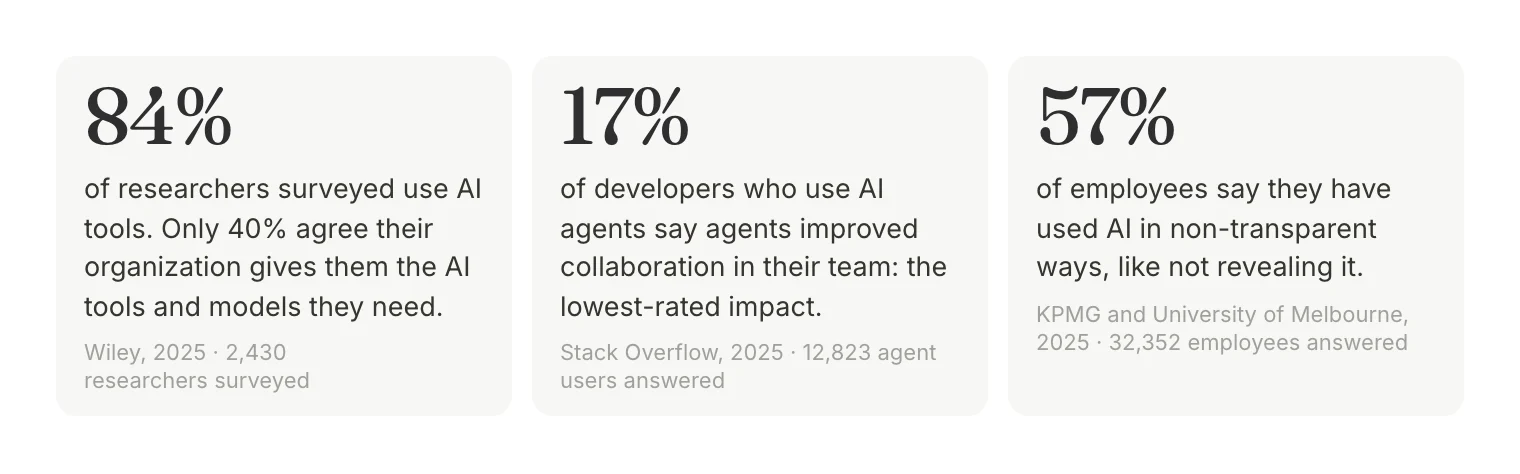
Most researchers already use AI. In Wiley's 2025 survey of 2,430 researchers, 84% said they use AI tools. Only 40% agreed that their organization gives them the AI tools and models they need (Wiley).
So people find their own. Each person picks a tool, learns what works, and keeps it to themselves. Outside the group Microsoft calls its most advanced AI users, only 36% say their teams share AI tips, agents, learnings, and mistakes (Microsoft Work Trend Index 2026).
That's the part we care about. Papers, interviews, data, and claims pass through many hands before they become a finding. When AI lives in private tabs, nobody else can see what it said, or check it.
We're a small product team, and we're going through this change ourselves. We build Mantle Chat, a workspace where teams and AI models work together. This article is based on published research, all linked below. It is not our own survey. It's the long version of our free playbook, Research with AI. Keep the thinking.
Seven problems research teams face
For each one: what the research says, and what helps. Most of these sources are surveys, so they show what people report, not measured outcomes. More on that at the end.
1. Not enough time
Only 45% of researchers in Elsevier's 2025 survey say they have enough time for research (Elsevier). In Lyssna's survey of 300 professionals who run research, time-consuming manual work was the most common synthesis pain, named by 60% (Lyssna).
What helps: let AI take the first pass on the repetitive parts: transcripts, first-pass themes, a weekly digest of new papers. Then spend the time you saved on the part AI can't do for you: judgment.
2. AI answers go unchecked
In a 2025 study by KPMG and the University of Melbourne, 66% of employees said they have relied on AI output without critically evaluating it. 56% said they have made mistakes in their work because of AI (KPMG).
What helps: make checking a step, not a hope. A fact-checking agent can find a source for every claim. A person then opens each source and confirms it, in a thread the whole team can see. There's a worked example below.
3. Critical thinking can slip
In a Microsoft Research and Carnegie Mellon study of 319 knowledge workers, more confidence in AI went with less self-reported critical thinking (Lee et al., CHI 2025). At the same time, in Maze's 2026 survey, 76% named framing the right questions as an area where human involvement is essential (Maze).
What helps: use AI to argue with you, not only to agree with you. Ask a model to challenge your method or your conclusion, then discuss the critique as a team. Question the critique too.
4. No shared rules for AI
Only 27% of researchers in Elsevier's survey say they have enough AI training, and 32% see good AI governance (Elsevier).
What helps: write the rules down once, where everyone works. A shared agent gives the whole team the same instructions, the same trusted sources, and the same way of rating evidence. The rules and the training still come from your team.
5. No shared research library
41% of the practitioners in Lyssna's survey find it difficult to identify patterns across different data sources (Lyssna). When past studies are scattered across drives, docs, and chats, every new study starts from zero.
What helps: one knowledge base for people and agents, so past studies are there when the next one starts. Someone still needs to keep it current.
6. More people run research
In Maze's survey, 39% say product managers conduct research in their organization. Fewer than half of organizations offer non-researchers structured training (46%) or research libraries (49%), and 13% report no resources at all to support them (Maze).
What helps: researchers become reviewers and coaches. When studies live in shared threads and documents, a researcher can review a discussion guide before the first session, not after the report.
7. Data is harder to verify
In one study, an AI agent passed 99.8% of 6,000 standard survey attention checks (Westwood, PNAS 2025). A 2026 NORC review cites estimates of 15–30% fraud across market research (NORC).
What helps: ask an agent to flag duplicates and inconsistencies, then have a person review what it flags. A unique answer can still be fake, so the check doesn't end with the agent.
Our approach: use AI together, and on purpose
Across all seven problems, the same four habits keep coming up:
- Quality over speed. AI does the first pass. Your team does the thinking.
- Check the source. Compare models, then open the original source. Agreement between models isn't proof.
- Review in rounds. Draft, get comments from teammates and AI, revise. A person signs off before anything goes out.
- Private stays private. Keep sensitive work in private chats, visible only to the people in them.
We tried to write the playbook the same way. It went through several drafts and three review rounds with other AI models, and we checked every number against its original source. The reviews caught real mistakes, including ours.
A worked example: a fact-checking agent
This is the most practical part of the playbook. Here's how a team can set up a fact-checking agent and use it every day:
- Draft it in one message. Ask Mantle AI: "Build a fact-checking agent for our team." It drafts the agent. You approve it, then test it on claims you already know the answer to.
- Choose the sources you trust. Add your source list to the agent's knowledge. A trusted type of source still needs checking, one study at a time.
- Check a call or an article. Reply to call notes, or paste a draft: "@fact-checker, check every claim."
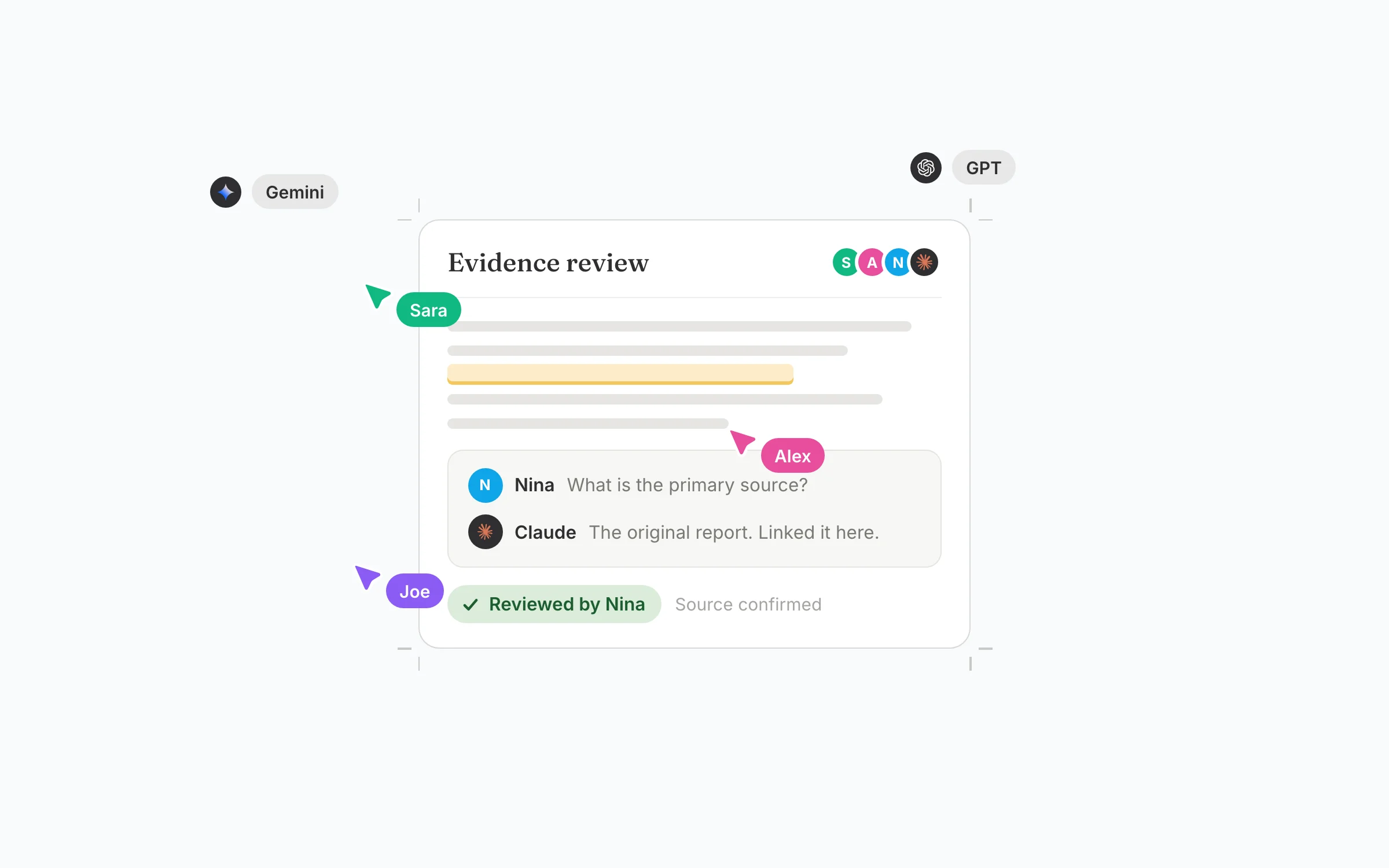
- Ask three models. Ask Claude, GPT, and Gemini the same question, and see where they agree and where they don't.
- A person reviews the evidence. Open the source and find the exact passage. Check the method, the date, and who it describes.
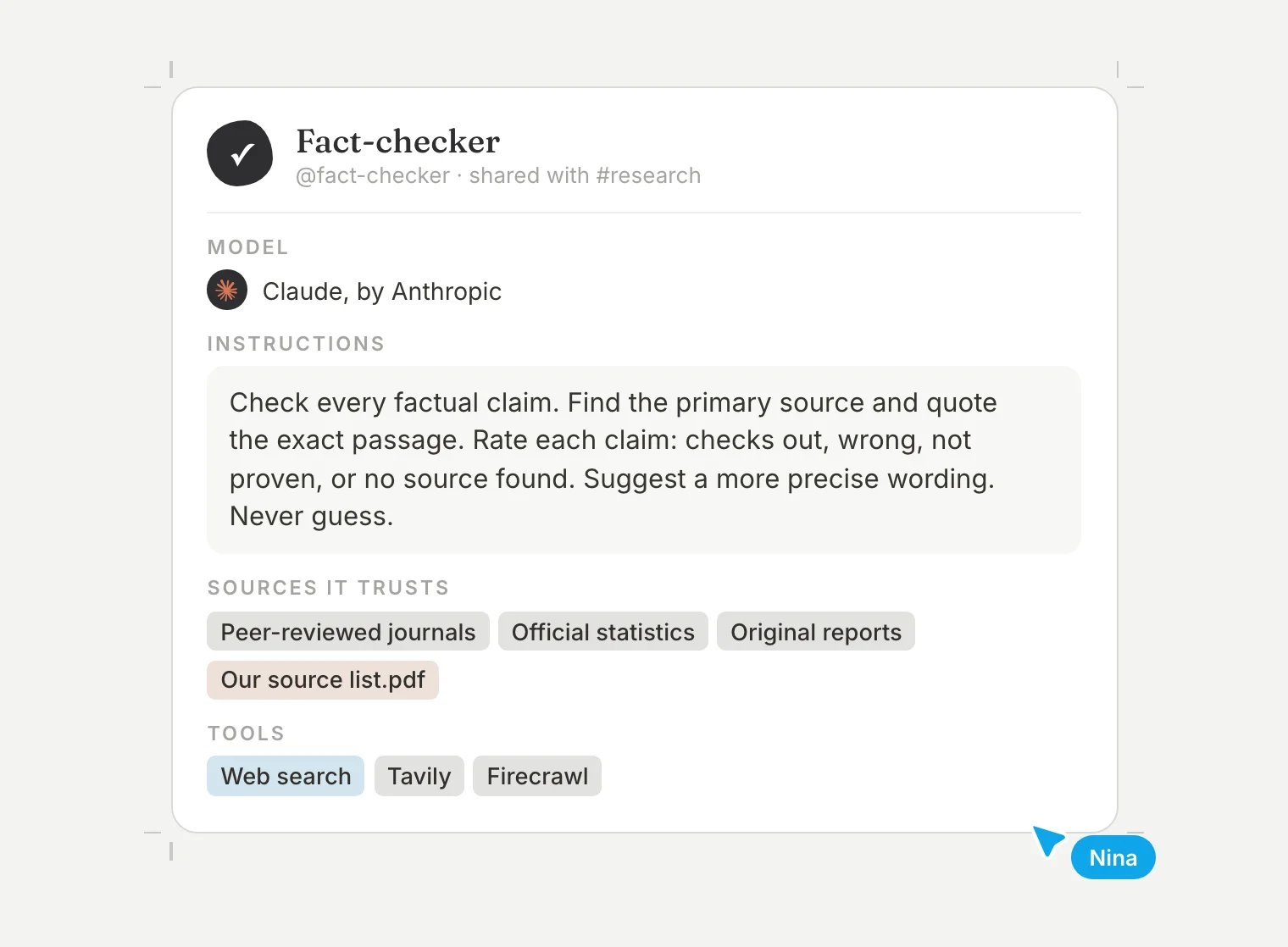
Here's a short version of its instructions:
Check every factual claim. Find the primary source and quote the exact passage. Rate each claim: checks out, wrong, not proven, or no source found. Suggest a more precise wording. Never guess.
And here's what it returns for a draft with five claims. We built this example from the playbook's own sources:
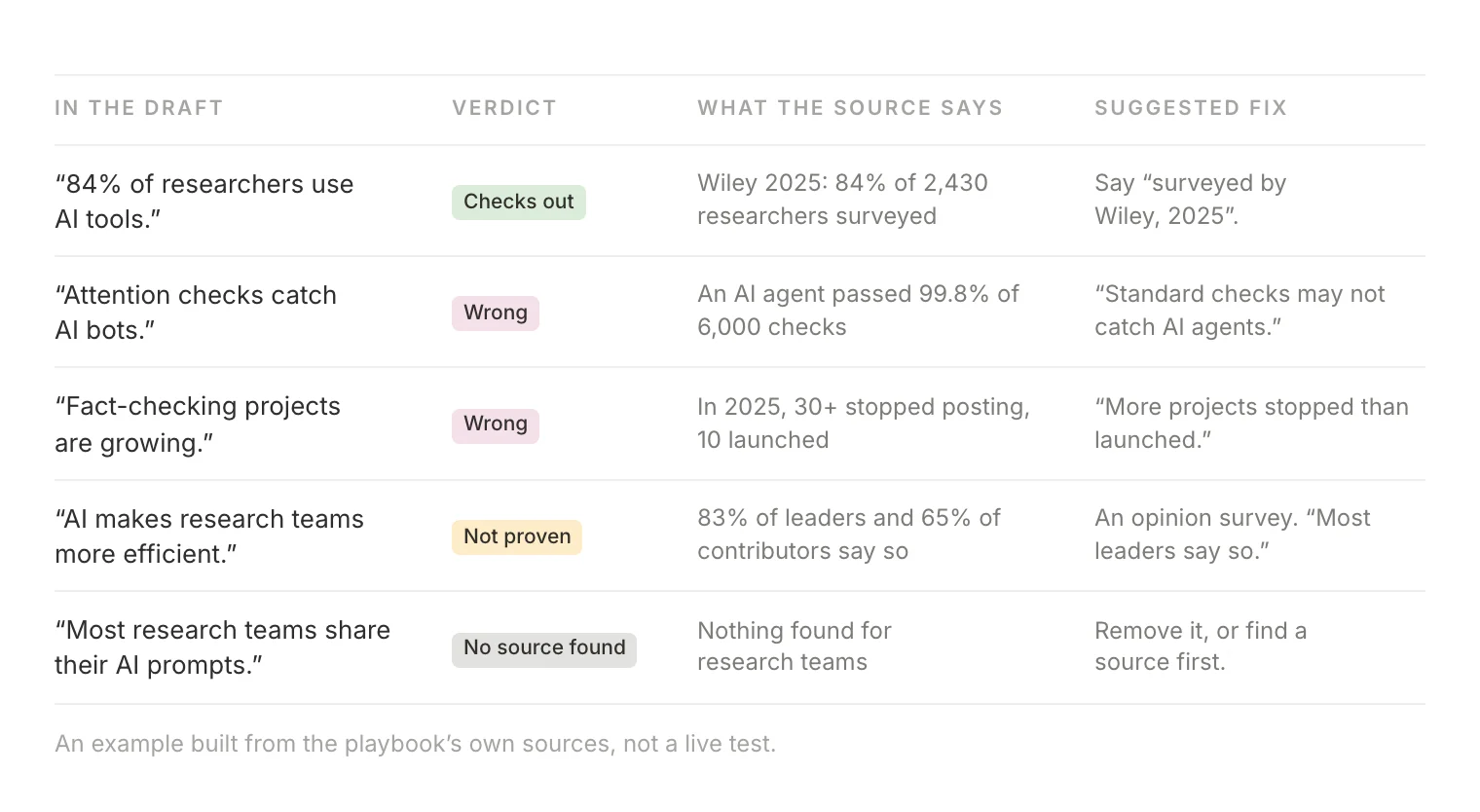
A few things worth noticing:
- "Checks out" means the source says so. It doesn't mean it's the final truth. The suggested fix still adds who was surveyed and when.
- "Wrong" is usually not a lie. "Attention checks catch AI bots" sounds safe to say, but in a 2025 study an AI agent passed 99.8% of 6,000 checks. "Fact-checking projects are growing" sounds right, but in 2025 more than 30 projects stopped posting and 10 launched (Duke Reporters' Lab).
- "Not proven" often means it's an opinion. In Qualtrics' 2026 survey, 83% of leaders and 65% of contributors say AI tools made their teams more efficient (Qualtrics). That's what people believe, not a measurement.
- "No source found" is a real result. Remove the claim, or find a source first.
The agent does the searching. People still do the checking.
The research journey, with your team and AI
To show where AI fits, we adapted the six stages of CASRAI's research project life cycle and added what the team and AI do at each one.
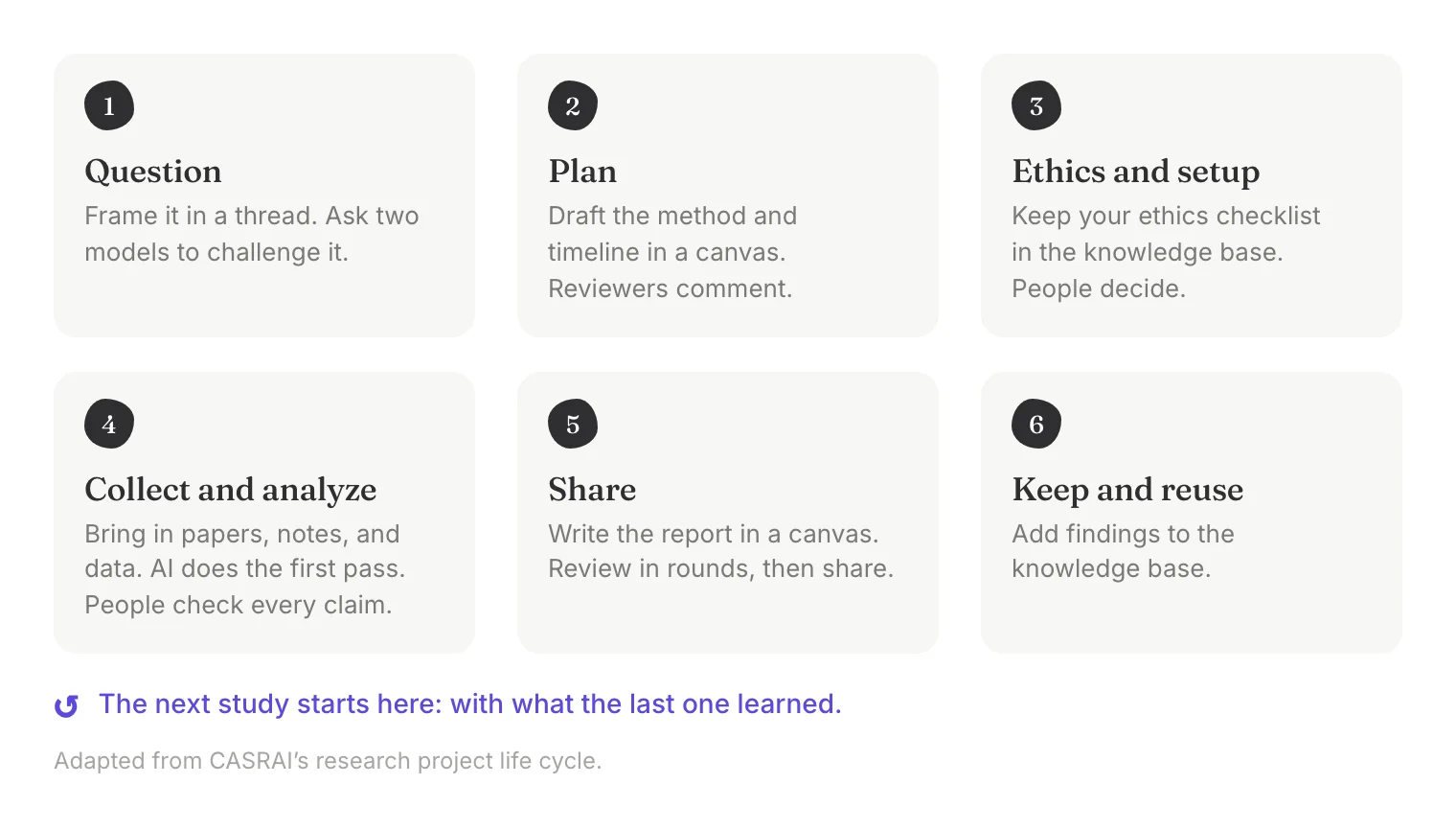
The last stage matters most. CASRAI calls reuse "the point of the whole lifecycle." When findings go back into a shared knowledge base, the next study starts with what the last one learned.
Six kinds of research, same habits
The playbook walks through six areas. Each one follows the same pattern: AI does the first pass, people check, and the work stays where the team can see it.
- UX & product research. Turn interviews into findings the team trusts. An agent groups what people said into themes, with quotes. Read each quote in context before you share.
- AI & technology research. Test AI tools before your team relies on them. Write 10 questions you already know the answers to, and ask several models the same questions.
- Market & competitive research. A weekly task checks five competitor sites and sums up what changed, with links. An analyst checks each claim before it goes into the report.
- Literature & evidence reviews. Upload the key papers. An agent builds a table of method, sample, and result. Where papers disagree, talk it through as a team.
- Fact-checking & verification. The agent above: AI finds sources, a person confirms, and the record stays.
- AI policy & impact research. A weekly task collects new studies and laws. Two models summarize a report, and you check both.
First steps
- Create a shared space. Ask Mantle AI: "Create a #research channel."
- Add your key sources once. Upload papers and reports to the knowledge base, so every agent and teammate works from the same material.
- Compare models. Paste a prompt and @mention two models. Notice where they disagree.
To know whether it works, pilot it on one report next to your usual process. Compare review time, errors fixed, and whether a colleague can find the source behind a conclusion.
Mantle Chat is free to start. Web search, scheduled tasks, and AI meeting notes are on paid plans.
What we still don't know
Most of the numbers here come from surveys, and several come from companies that sell research tools. They show what people report, not measured outcomes. We chose sources we could read in full and link, not through a systematic search.
We also haven't seen good published data on whether team review of AI output leads to better research over time. We believe it does, but that's a hypothesis, not a finding. If you're measuring it, we'd love to learn from you.
Get the playbook. Research with AI. Keep the thinking. is a free 7-page playbook for research teams who want to use AI together: the seven problems with sources, the fact-checking agent step by step, six kinds of research, and first steps. Ask us for a copy, and ask for the full fact-checker instructions too.
Sources
- Microsoft, Work Trend Index 2026. 20,000 full-time workers in 10 countries.
- Wiley, ExplanAItions 2025, key findings. 2,430 researchers, August 2025.
- Stack Overflow, Developer Survey 2025. 12,823 developers answered the question on AI agents.
- KPMG and University of Melbourne, Trust, attitudes and use of AI 2025. 32,352 employees answered questions about AI at work.
- Elsevier, Researcher of the Future 2025. 3,200+ researchers in 113 countries.
- Lyssna, Research Synthesis Report 2025. 300 professionals in 34 countries, May 2025.
- Lee et al., Microsoft Research and Carnegie Mellon, The Impact of Generative AI on Critical Thinking, CHI 2025. 319 knowledge workers.
- Maze, Future of User Research Report 2026. Nearly 500 researchers and product professionals.
- Westwood, The potential existential threat of large language models to online survey research, PNAS 2025.
- NORC at the University of Chicago, Fraudulent respondents and bots in nonprobability surveys: A literature review, April 2026.
- Duke Reporters' Lab, Fact-Checking Census 2026.
- Qualtrics, Market Research Trends 2026. 3,000+ researchers in 17 countries.
- CASRAI, The Life Cycle of a Research Project, updated July 18, 2026.